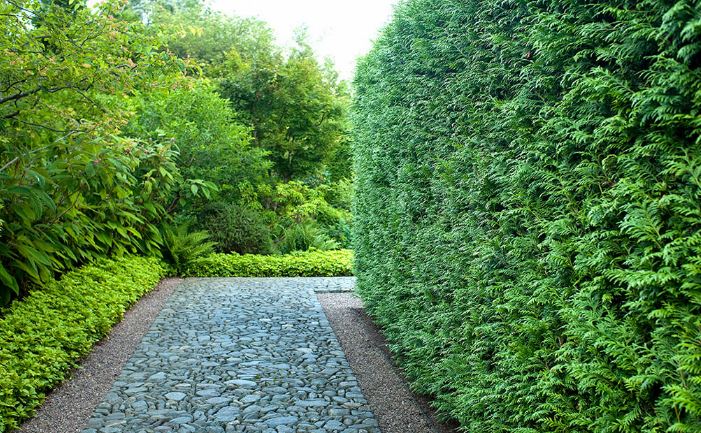
Hedges are not only ideal for structuring the garden and ensuring privacy, but also for creating a green oasis. But not all hedges are equally easy to care for. But if you appreciate an easy-to-maintain garden and don’t want to put up a fence as privacy protection, you’re in the right place. Here we compare the care effort for the popular classic clipped hedges Thuja Smaragd, Leyland cypress, hornbeam, yew, cherry laurel, privet and European beech.
1. Thuja Smaragd – The elegant classic among evergreens
- irrigation: Thuja Smaragd, in order to grow well, requires regular watering in the first years, especially on hot days. If the roots are deep enough, it usually gets along well with rainwater.
- Pruning: It needs topiary once or twice a year to maintain its compact shape. Thuja grows rather slowly, so the topiary remains very manageable and does not require much work.
- Labs: Since the thuja is evergreen, the foliage remains on the plant in winter, so you don’t have to harvest anything.
- Fertilization: Thuja needs long-term fertilizer in spring, but once a year is enough. A nitrogen-based conifer fertilizer (e.g. blue cereal) is ideal.
- Additional treatments? Make sure it is in a good location so that the planting is not too thick and the soil is good. It doesn’t like standing water, then it will work!
Conclusion: Thuja Smaragd is easy to care for as long as the site conditions are right. So it doesn’t take much work for you, but it provides very strict privacy protection!2. Leyland Cypress – Fast growing privacy shielding
- Irrigation: Like Thuja, Leyland cypress needs a lot of water in the first year. After that, it works well without additional water, unless the location is very dry and unprotected.
- Pruning: This hedge grows extremely quickly (up to 1 meter per year), which requires regular and frequent topiary – at least two to three times a year to maintain the desired height and shape. There is very fast privacy protection for that!
- Lab: Being an evergreen hedge plant, it retains its foliage in winter, so there is no leaf drop, there is nothing to do.
- fertilization: A nitrogen-rich fertilizer in spring and a potash fertilizer in late summer are ideal for supporting growth and increasing resilience.
- Additional treatments? Leyland cypress is quite sensitive to frost and drought, so in problematic places it requires some additional effort (in winter, for example, cover the soil with bark mulch).
Conclusion: Due to its rapid growth, several cuts per year cannot be avoided, but with the Leyland cypress you get a very dense, elegant and evergreen privacy screen!
3. Hornbeam: Rugged classic for mixed environments
- irrigation: Hornbeams are hardy and generally only need additional water during long periods of drought.
- Pruning: Hornbeam should be cut once or twice a year to maintain its shape.
- Labs: Hornbeams are deciduous, the leaves often remain on the branches all winter. Leaf fall is therefore relatively low.
- fertilization: Hornbeams generally do not require particular fertilizers. If growth is weak, you can use a long-term organic fertilizer in the spring
- Additional treatments: Hornbeams are very robust and resistant to diseases and parasites; As long as the location is not too dry or too humid, hornbeam care is extremely easy!
Conclusion: Hornbeam is a low-maintenance choice, especially if you want a robust, disease-resistant hedge. It is also characterized by its contribution to ecodiversity in the garden, which is why it fits well into a natural garden.
4. Rate: durable and versatile
- Irrigation: Yew trees are very easy to care for and only require additional water in extremely dry periods.
- Pruning: Yew trees grow slowly and only need to be cut once a year, making them particularly easy to care for.
- Labs: Evergreen, therefore without leaf fall.
- Additional treatments? Yew trees also tolerate deep pruning well and regenerate quickly. They are considered disease and pest resistant and grow in both shade and sun. It couldn’t be easier to take care of!
Conclusion: The yew is one of the easiest hedge plants to care for and is ideal for you if you want to invest little time in hedge care. The dark needles make them look sober and modern. However, all its components are poisonous.
5. Cherry laurel: easy to care for but fast growing
- Irrigation: Cherry laurel generally tolerates drought well and only needs regular watering after planting to thrive.
- Pruning: Cherry laurel grows quickly and therefore needs pruning at least twice a year to maintain its shape.
- susceptibility to diseases: Cherry laurel is relatively resistant to disease, but is susceptible to leaf spot and powdery mildew in high humidity conditions.
- Labs: Evergreen, therefore without leaf fall.
- Fertilization: Cherry laurel needs fertilizer in the spring, preferably a long-term, nitrogen-rich fertilizer. Compost can also be used to promote growth.
- Additional treatments? Cherry laurel feels most comfortable in places protected from the wind. Too much sun or drought can damage the leaves.
Conclusion: Cherry laurel is relatively easy to care for, but its rapid growth requires regular pruning. (Portuguese cherry laurel or «classic cherry laurel»). Here too, privacy protection is very tight!
6. Privet – For flexible gardeners
- Irrigation: Privet is drought tolerant and requires adequate water only in the first few years after planting.
- Pruning: It grows quite quickly and requires pruning at least twice a year.
- Susceptibility to diseases: It is robust and resistant to many diseases.
- Labs: Depending on the species, privet is evergreen or deciduous. However, leaf drop is manageable.
- Fertilization: Privet benefits from spring fertilization with a slow-release organic or mineral fertilizer to stimulate growth
- Additional treatments? Privet is versatile and adapts well to different soil conditions.
Bottom line: Privet is easy to care for, but requires regular pruning to maintain the desired shape and may even produce some leaves.
7. European Beech – The natural privacy screen
- Maintenance effort: Medium to high
- Irrigation: European beech trees need regular watering in the early years, especially in drought conditions.
- Pruning: They grow quickly and require pruning at least once a year.
- Susceptibility to diseases: European beech trees are resistant to many diseases, but are susceptible to beech aphids and fungal attacks.
- Lab: European beech trees are deciduous, but the leaves often remain on the branches all winter. Collecting leaves is therefore only necessary in spring.
- Fertilization: European beech trees should be fertilized in spring with a nitrogen fertilizer or organic compost to stimulate growth.
- Additional treatments? Deep pruning can greatly stimulate growth, so regular pruning is important.
Conclusion: European beech trees are sturdy and malleable and require just a little more care in the first few years. Since it does not grow as quickly as the hornbeam, it is even easier to care for it in the long termConclusion: Which hedge is the easiest to care for?
Die badger Overall it seems to us to be the easiest hedge to care for, as it requires little water, is resistant to diseases and only requires annual pruning and is otherwise very robust and long-lived. Since it grows well in the shade and forms dense hedges, it is a real all-rounder!
Beech and common hornbeam are also a great choice for time-pressed gardeners, as they are hardy and require little maintenance. Thuja smaragd and cherry laurel require a little more work, but are still easier to care for than Leyland cypress, which requires a little more attention due to its rapid growth and susceptibility to drought.
However, our comparison also shows that the care necessary for all these classic hedge plants is truly limited. Even if an easy-to-maintain garden is important to you, we recommend a hedge instead of a fence. 🙂
You can find more information about these classic hedges in this blog post. Inspiration for hedges made from native trees, which are a little less known but also very beautiful, can be found here.
If you need help choosing the right hedge plant for your custom garden project, contact us!
latest posts published

Taking over a craft business: purchase, legal issues and more

Estimating costs in commercial transactions: it doesn’t always have to be free!

The 10 most important questions in summary

Plant, care for and trim harlequin willow correctly
Fast-growing trees and shrubs for impatient gardeners: chaffinch

How do we choose the right carpet? – Select Design

Building Information Modeling (BIM) for merchants

Best practices in financing management

This will change for artisans in 2025